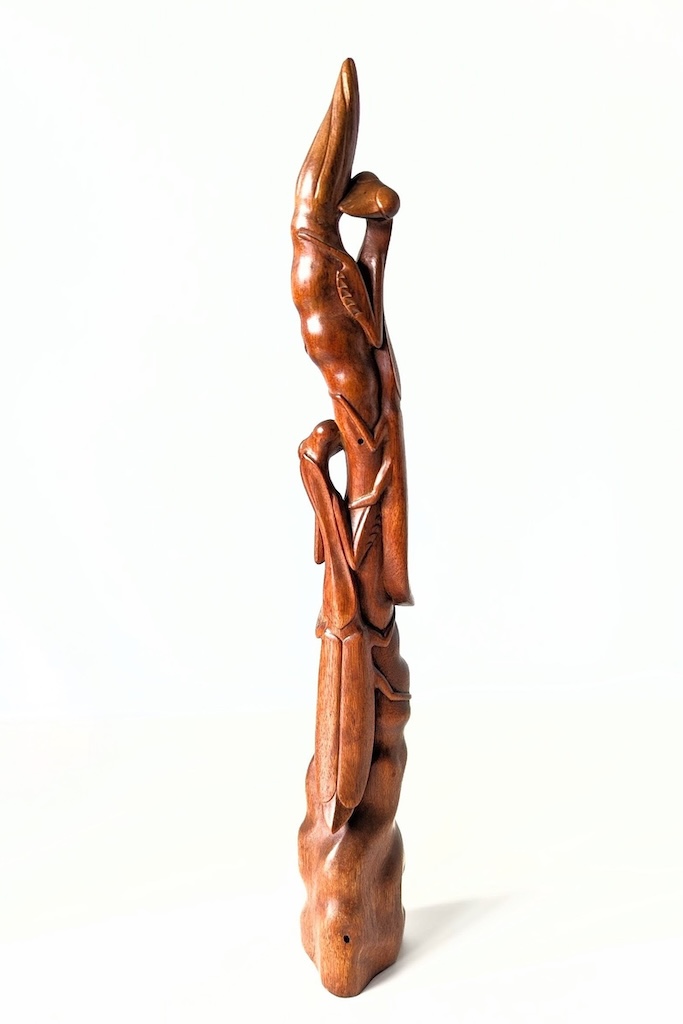
This Balinese woodcarving of two praying mantises climbing a plant, was probably made in the late 1940s. It was purchased around 1945-1947 by the first owners. The statue is an early example of the elongated style in Balinese woodcarving art, which emerged in the 1930s and continued into the 1970s. Praying mantises have long bodies and thin legs, making them well-suited to this woodcarving style.
Moreover, praying mantises are fascinating creatures that have captivated scientists and artists for centuries with their unique blend of elegance and ruthless efficiency. Their folded forelegs resemble a prayer, but are in fact a deadly weapon. Praying mantises can strike with a speed of 30 milliseconds; too fast for the human eye to follow. By depicting a pair of them, the woodcarver also refers to the balance between life and death. Because the female is known to eat the male after (or during) mating, praying mantises symbolize the cycle of sacrifice and creation.
Messenger from the spirit world
The Balinese name for a praying mantis is walang kekek or in Indonesian belalang sembah. Sembah is the traditional Indonesian greeting in which the handpalms are pressed together as a sign of deep respect and reverence for both god(s) and fellow human beings. On Bali, the praying mantis is seen as a living symbol of this sacred act. Because the insect literally embodies this posture, it is regarded as a natural teacher of reverence. It reminds people that spirituality is not separate from daily life, but is inextricably linked to it.
Due to the strong focus on animism within Balinese Hinduism, the praying mantis is often regarded as a messenger from the spirit world. It is believed that spirits can manifest themselves in small creatures such as insects. A praying mantis in a temple or on a home altar is seen as an auspicious sign or an encouragement to pray. The insect also symbolizes silence and concentration. This aligns with the concepts of meditation, which are essential for achieving balance between good and evil forces on the island.
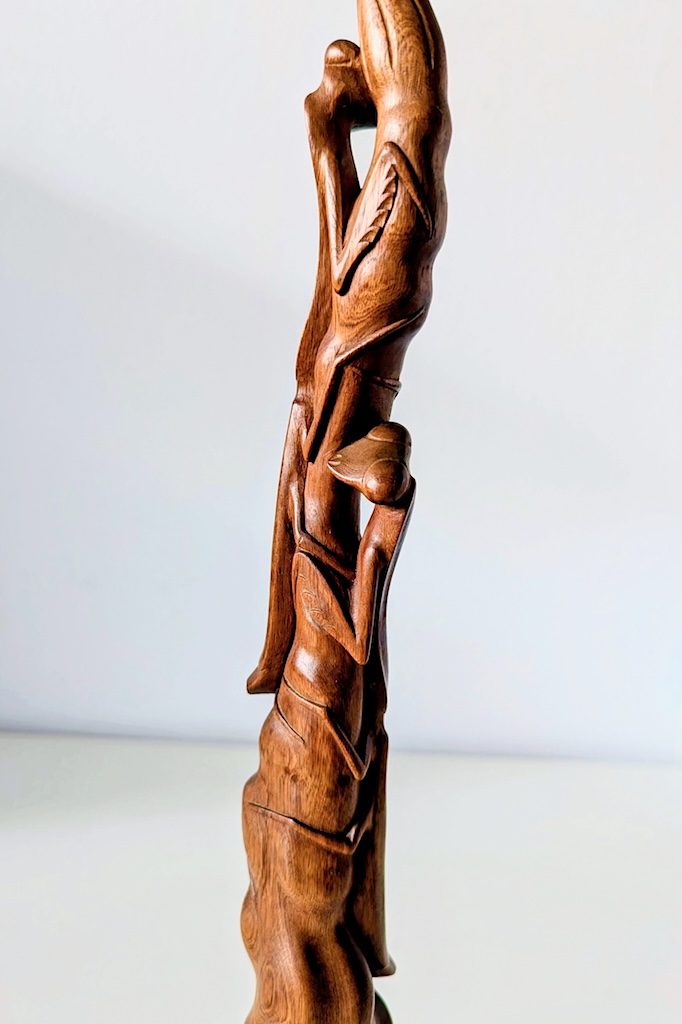
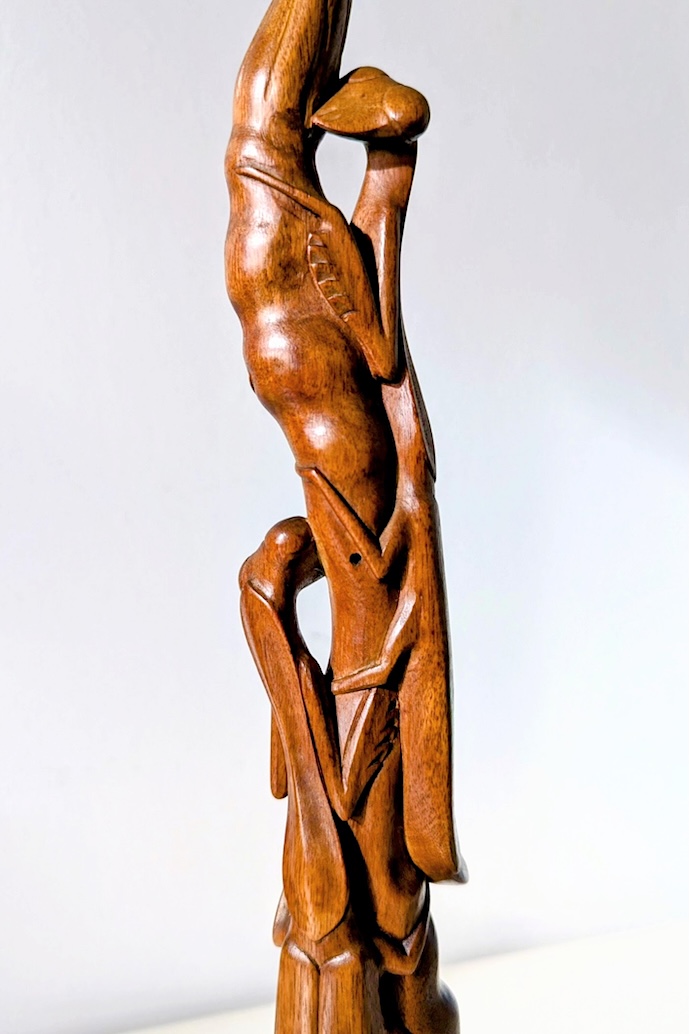
Woodcarving of two praying mantises climbing a plant, symbolizing the cycle of sacrifice and creation. Carved around 1945-1947, height: 34 cm.
Symbol of taksu (spiritual power)
Taksu is a Balinese concept for divine inspiration or a creative/spiritual spark. The intense focus and lightning-fast reaction of the praying mantis are seen as a physical manifestation of taksu. The insect symbolizes the state of being fully present in the moment, which is essential for Balinese dancers, artisans, and priests.
In the Indonesian martial art of pencak silat – which is also popular in Bali – the praying mantis is one of the most revered sources of inspiration for movements and strategies. Many styles mimic the unique characteristics of this insect to create an effective form of defense. Just like a real praying mantis, a pesilat (practitioner) learns to wait patiently for the opponent to make a mistake. The insect is known for its ability to remain perfectly still for minutes only to strike in a fraction of a second.
Indonesian fables
Praying mantises regularly appear in Indonesian and Balinese fables, such as the story of the pious mantis and the busy cricket. The story goes as follows:
One day, a praying mantis sits perfectly still on a branch in the hot sun, his forelegs folded as if he were praying. A busy, noisy cricket passes by and mocks the mantis. ‘Why are you sitting there praying so boringly? Come play!’ says the cricket. The praying mantis does not answer, but continues to stare with his big eyes. The cricket jumps back and forth carelessly. Suddenly, when the cricket gets too close, the mantis shoots out of his “praying” posture with lightning speed and grabs the cricket. The moral: patience and camouflage (cleverness) triumph over hubris and busyness. The “pious” posture is merely a cover for the hunt.
 Art Deco Bali blog