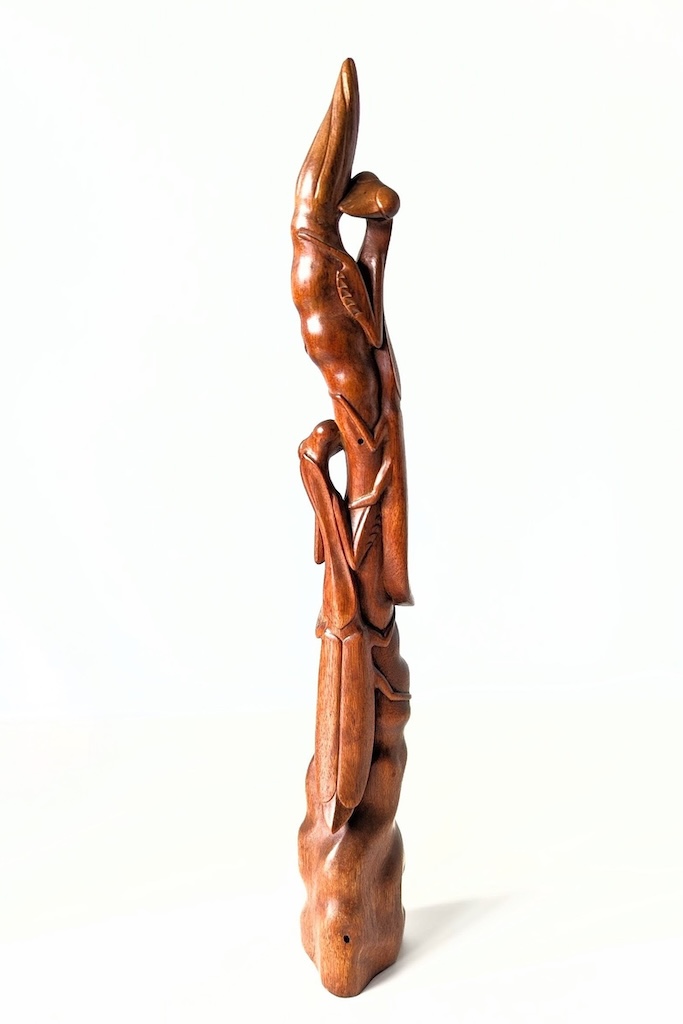
This Balinese woodcarving of two praying mantises climbing a plant, was made around 1950. The statue is an early example of the elongated style in Balinese woodcarving art, which emerged in the 1930s and continued into the 1970s. Praying mantises have long bodies and thin legs, making them well-suited to this style.
Symbolic meaning
The Balinese name for a praying mantis is Belalang Sembah. Sembah is the traditional Balinese greeting in which the handpalms are pressed together as a sign of deep respect and reverence for both gods and fellow human beings. On Bali, the praying mantis is seen as a living symbol of this sacred act. Because the insect literally embodies this posture, it is regarded as a natural teacher of reverence. It reminds people that spirituality is not separate from daily life, but is inextricably linked to it. The praying mantis also symbolizes silence and concentration. This aligns with the concepts of meditation, which are essential for achieving balance between good and evil forces on the island.
Messenger from the spirit world
As elsewhere in Indonesia, the praying mantis on Bali is often regarded as a messenger from the spirit world. Due to the strong focus on animism within Balinese Hinduism, it is believed that spirits can manifest themselves in small creatures such as insects. A praying mantis in a temple or at a home altar is often seen as an auspicious sign or a reminder to pray.
Symbol of Taksu (spiritual power)
Taksu is a Balinese concept for divine inspiration or a creative/spiritual spark. The intense focus and lightning-fast reaction of the praying mantis are seen as a physical manifestation of Taksu. The insect symbolizes the state of being fully present in the moment, which is essential for Balinese dancers, artisans, and priests.
Pencak Silat
In the Indonesian martial art of Pencak Silat, the praying mantis is one of the most revered sources of inspiration for movements and strategies. Many styles mimic the unique characteristics of this insect to create an effective form of defense. Just like a real praying mantis, a pesilat (practitioner) learns to wait patiently for the opponent to make a mistake. The insect is known for its ability to remain perfectly still for minutes only to strike in a fraction of a second.
 Art Deco Bali blog