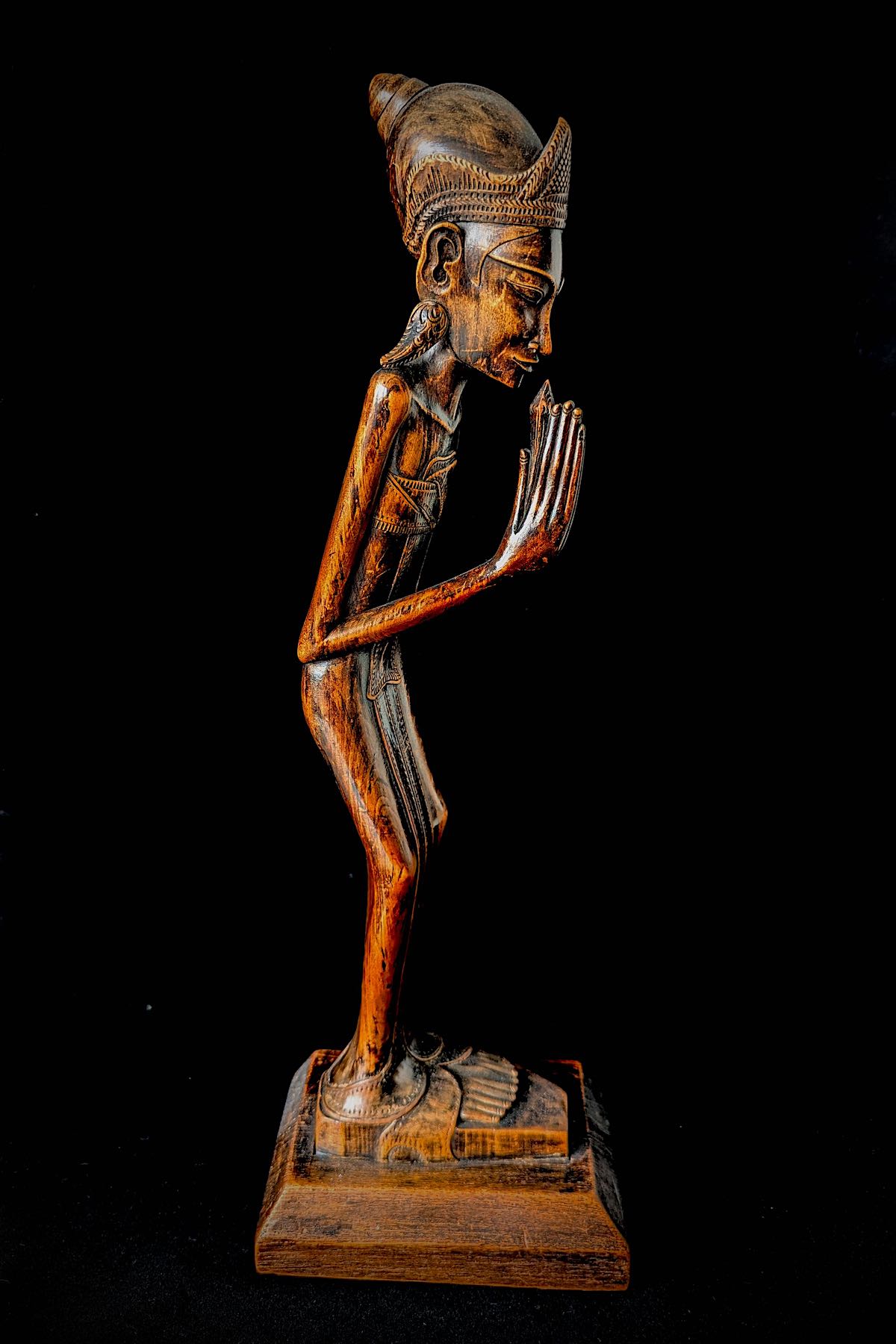
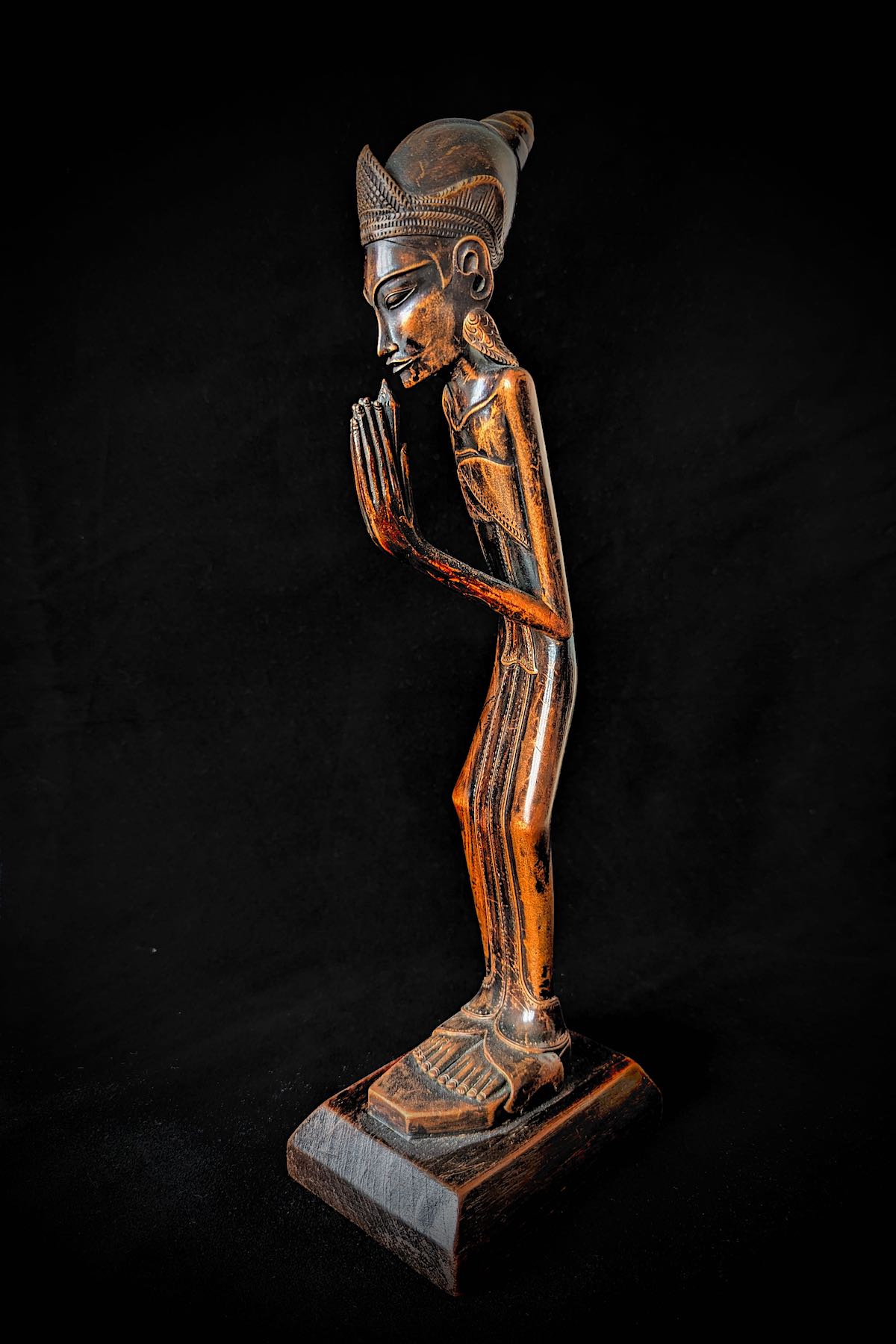
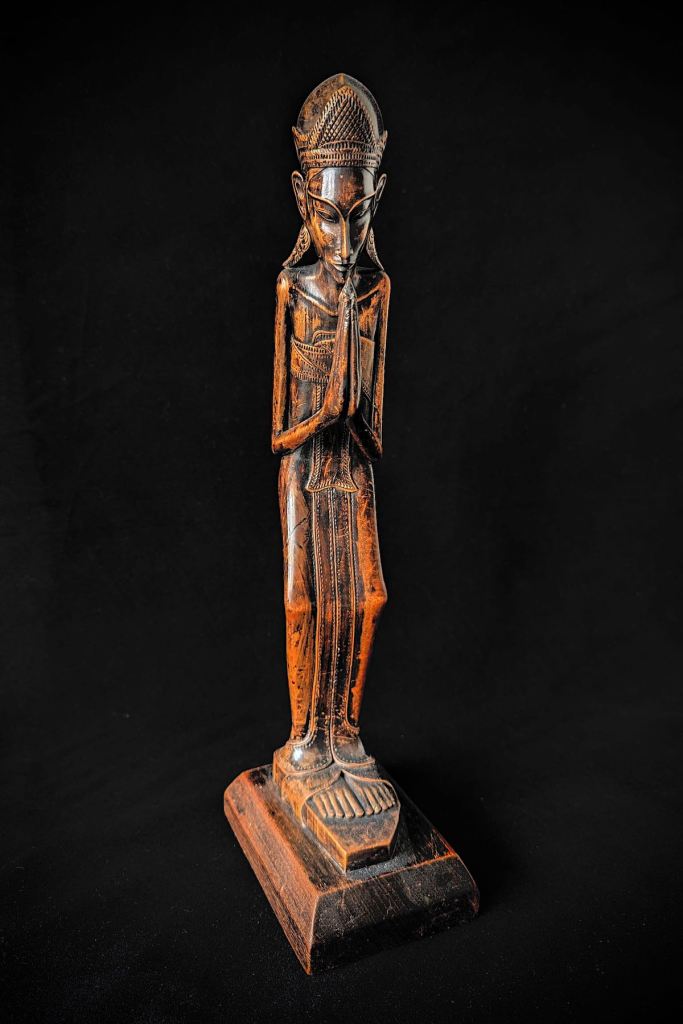
This woodcarving depicts a Pedanda Siwa (Balinese priest) in a praying or blessing pose. The elongated and stylized statue was probably made before the Second World War. It still has its original dark patina.
In the 1930s, a number of master carvers experimented with elongated statues. The story goes that one of them was given a long piece of wood to carve two statues from. However, the woodcarver could not bring himself to cut the beautiful piece of wood in half. He made one slender figure of it, which was so well received that other woodcarvers also started making elongated statues. This gave rise to a new style that continued into the 1970s. Pre-war elongated woodcarvings are very rare and usually damaged because of the thin, vulnerable limbs of the figures. A completely intact example such as this priest is difficult to find.
A Balinese priest doesn’t stand between a worshipper and a god; he’s there to make sure a person’s prayers are properly directed so the desired results may be achieved. Before a family moves into a new house or opens a shop, a priest is asked to give the god’s blessing. Priests purify people after an accident or illness, avert curses and bring people out of spells and trances.
Pedanda and pemangku priests
There are two types of Balinese priests: the pedanda, a high priest who conducts the larger and complex religious ceremonies, and the pemangku, a lay priest who maintains the temple and performs everyday rituals. Only a Brahmin can become a pedanda; pemangkus are recruited from the lower castes.
A pemangku is according to the Balinese “born once”, from the mother, which is why they are considered human. A pedanda is “born twice”: from the mother and a second time from a nabe (holy guru). Because of this, pedandas are considered superhuman in the field of spirituality, making them able to provide spiritual guidance and lead important ceremonies. They can enter into a trance state to become an empty medium through which the gods can talk to the people.
It is said that all pedanda priests are directly descended from Wau Rauh, the highest priest of the Majapahit Empire (1292-1527). Brahmin women can also become priests. They are called Pedandas Istri.
 Art Deco Bali blog