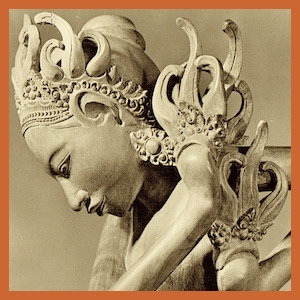
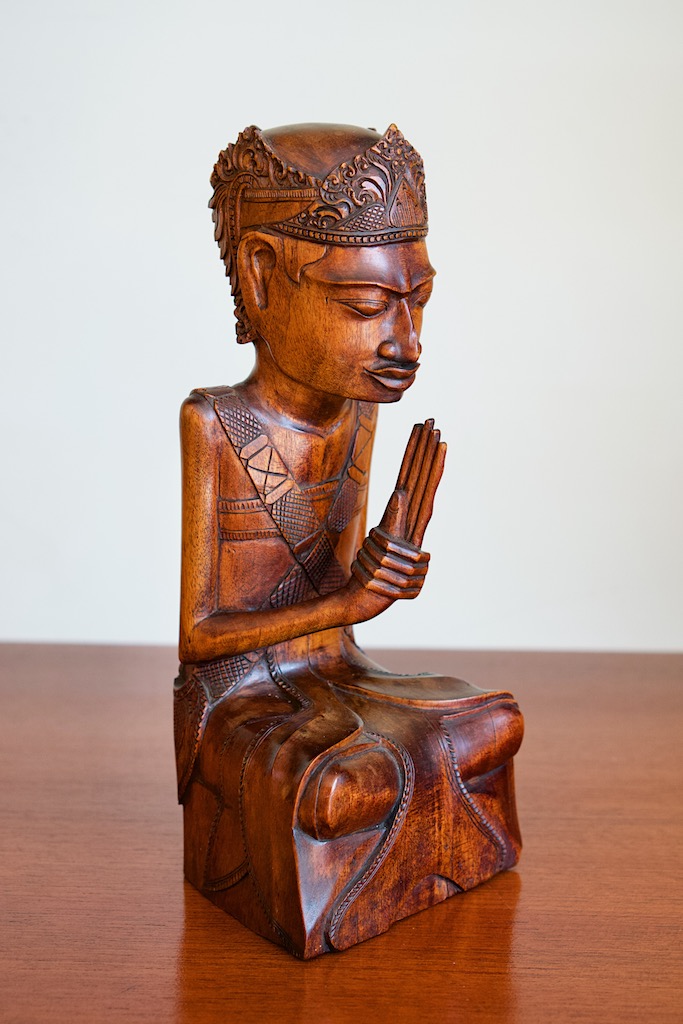
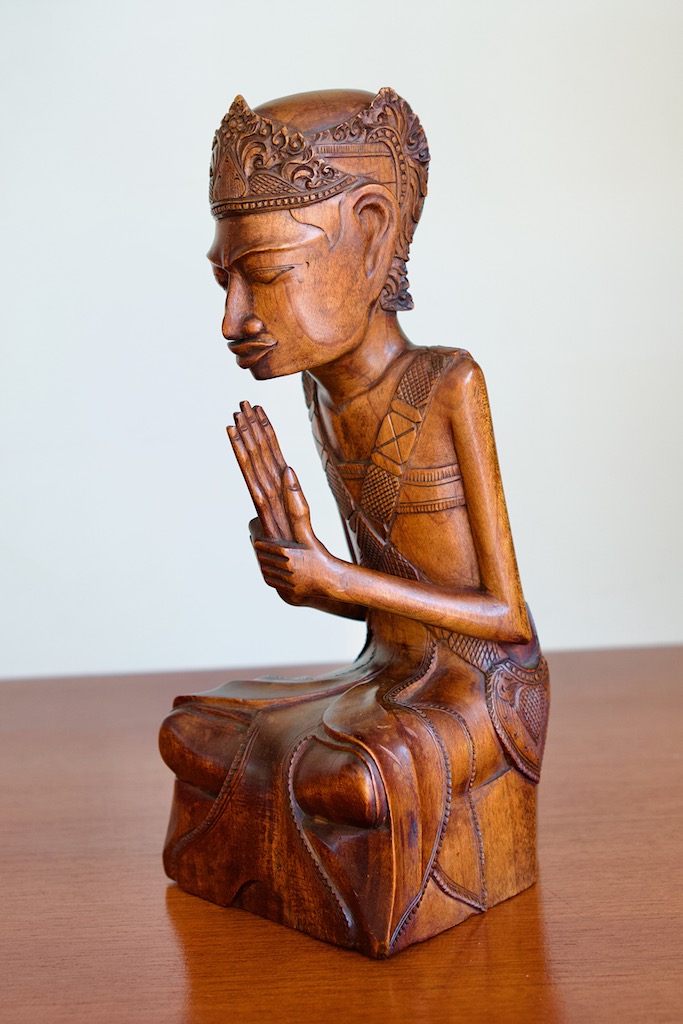
This is one of my favorite wood carvings. The statue represents a pedanda, a Balinese priest. The priest sits in a prayer position and makes a mudra, a ritual hand gesture with a blessing and healing effect. He wears a decorated hat and two prayer belts that run from his left shoulder to his right hip and vice versa. The stylized posture, thin limbs, long fingers, almond-shaped eyes and curled lips are characteristic of the modern woodcarving style from the 1930s.
Unlike most other priest carvings from this period, this pedanda is not depicted with the usual ceremonial objects, such as a prayer bell, holy water vessel and censer. Instead, the focus of the carving is mainly on the face and hands of the priest, which gives the statue a serene appearance.
Pedanda and pemangku
There are two types of Balinese priests: the pedanda, a high priest who conducts the larger and complex religious ceremonies, and the pemangku, a lay priest who maintains the temple and performs everyday rituals. Only a Brahmin can become a pedanda; pemangku are recruited from the lower castes. A pemangku is according to the Balinese “born once”, from the mother, which is why they are considered human. A pedanda is “born twice”: from the mother and a second time from a nabe (holy guru).
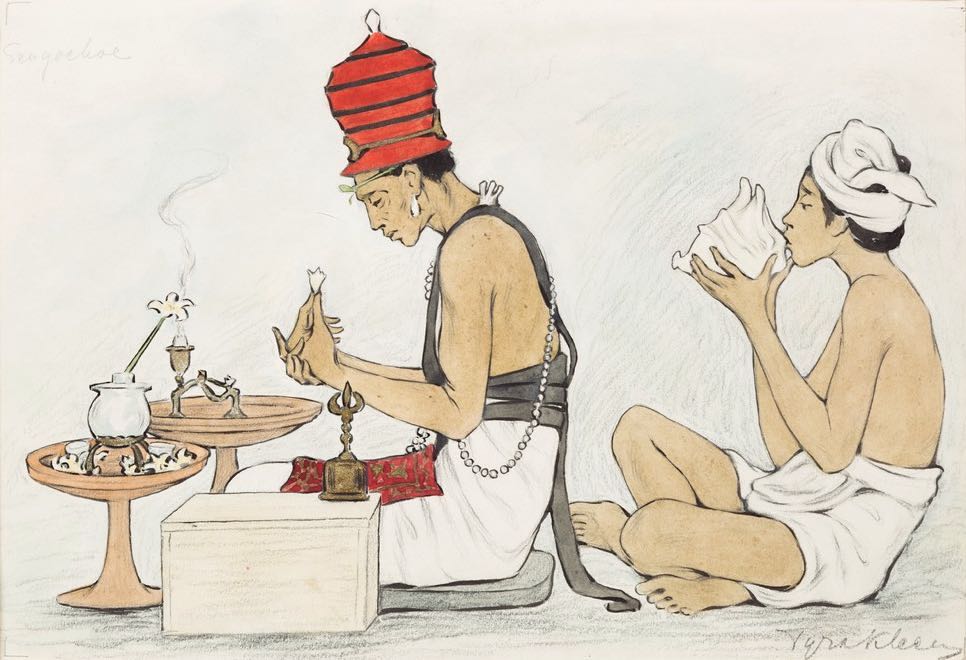
To complicate matters further, there are two schools within Balinese priesthood: the Pedanda Siwa and the Pedanda Buddha. This has to do with the history of the Balinese religion, which was influenced by both Javanese Hinduism and Javanese Buddhism. The Siwa pedandas worship Siwa, the supreme god in Balinese Hinduism. The Buddha pedandas worship both Siwa and Buddha, who are seen as identical gods, just called by different names. Siwa pedandas and Buddha pedandas have slightly different rituals but can also work together in larger ceremonies
The Siwa and Buddha pedandas can be distinguished from each other by their appearance. For example, a Pedanda Siwa always wears a black hat and a Pedanda Buddha a red hat. Another visible difference is the hairstyle. A Pedanda Siwa usually has long hair, which is rolled up in a circle on top of the head, while the Pedanda Buddha usually has his hair cut shorter to just below the ear. Based on the hairstyle of the priest statue, we can conclude that it’s probably a Pedanda Buddha.
 Art Deco Bali blog