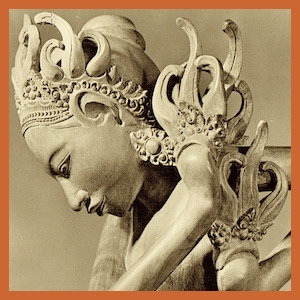
Many Balinese wood carvings have a deeper mythological meaning. Unfortunately, much of this knowledge has been lost. Names of gods are often mixed up and statues of goddesses are often described as ‘dancers’. There is also often a special story behind statues of animals.
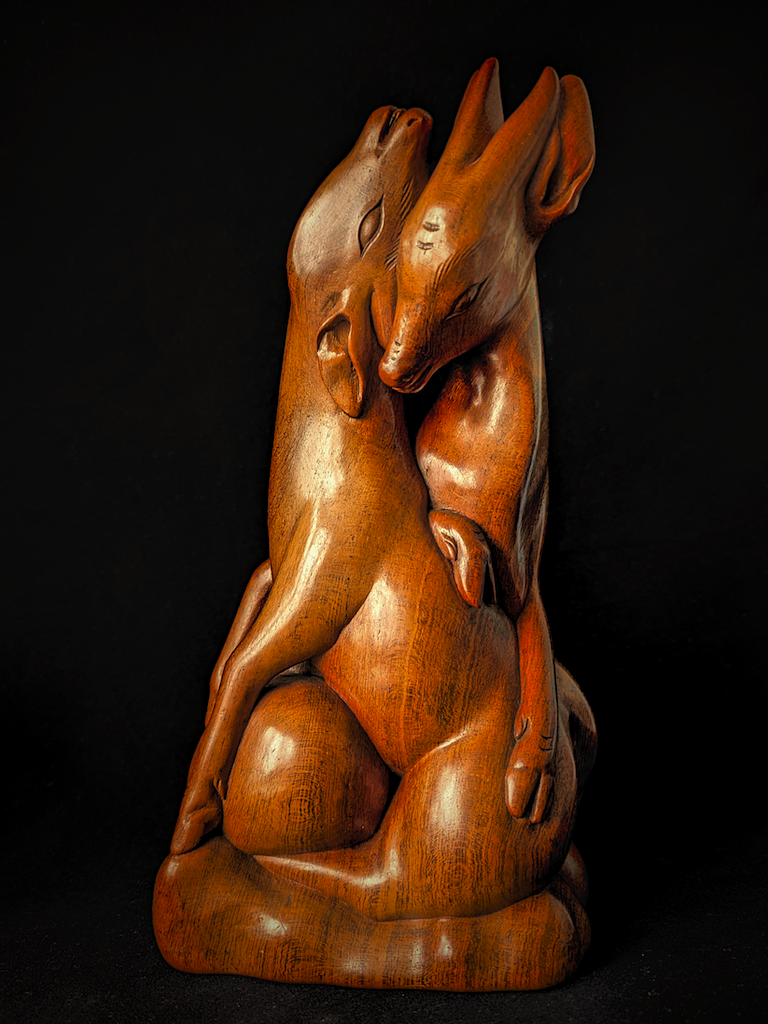
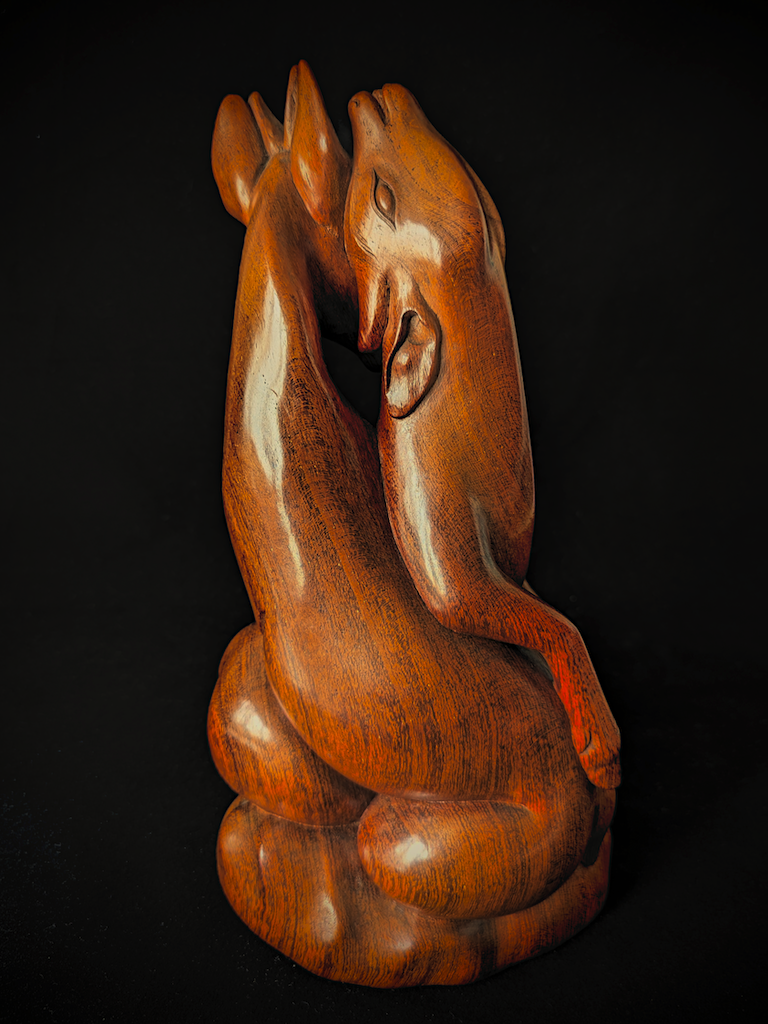
If you don’t know better, this wood carving looks like a stylized sculpture of two deer in love. But the story behind the statue is about Begawan Kindama. This spiritual sage from the Mahabaratha lived in the woods and was able to turn himself and others into animals.
One day, Kindama and his wife made love in the form of two deer, when the young king Pandu was hunting in the woods. Mistaking them for real dear Pandu shot them with his deadly arrows. Before dying, Kindama cursed the king that he would die the moment he made love to any woman.
Realising that he wouldn’t be able to produce an heir to the throne, Pandu resigned from his post as the king. He handed the kingdom over to his brother Dhritarashtra and went to the forest to live there in celibacy with his wives Kunti and Madri.
Thanks to a spiritual mantra given to her by another sage, Kunti had three sons from different gods: Yudistira, Bima, and Arjuna. At Pandu’s request, she shared the mantra with Madri, who also bore two divine sons (the twins Nakula and Sahadewa). The five boys were raised by Pandu as his own children. They are known as the famous Pandava brothers, who fought against their cousins, the Kauravas, during the great Mahabharata war.
Pandu died a few years after the birth of his (foster) sons. One day, he was filled with lust for Madri, when he saw her naked body after she had bathed. Despite her pleas, he tried to make love to her. After the act, his curse was fulfilled and he died. His body was cremated within the forest. Overwhelmed with grief and guilt, Madri then performed sati (self-immolation) on Pandu’s funeral pyre, after handing her children over to Kunti.
The statue of the two deer thus refers to an important event in the Mahabaratha epic and has not only a decorative value but also a religious meaning. The stylized design and flowing lines of the carvings are reminiscent of European statues from the Art Nouveau and Art Deco periods. Typically Balinese, however, are the subtle and playful details. Notice, for example, how the buck tenderly places its paws on the back and butt of the doe.
The bottom of the statue is penciled with ‘1934’, right where the price tag once was. This was likely done by the first owner to commemorate a visit to Bali. If the dating is correct, this woodcarving is an early example of Balinese art influenced by Western sculpture.
 Art Deco Bali blog