The magazine ‘Het Indisch Nieuws’ (Indonesian News) existed for just over a year. The first issue came out on September 22, 1945, shortly after Japan’s capitulation on 15 August 1945 and the declaration of Indonesian independence by Sukarno and Mohammad Hatta two days later. The last issue of the magazine appeared on November 23, 1946 when the first ships with conscripted Dutch soldiers arrived in Indonesia and the power struggle was about to begin.
Although the magazine presented itself as an independent weekly about the developments in Indonesia, it was mainly loyal to the Dutch cause. It acted as a mouthpiece for the Dutch authorities and supported the military intervention to restore colonial authority in Indonesia.
‘Now more than ever it is necessary, in order to maintain our place in the ranks of nations, for the Dutch population to realize what the Kingdom of the Netherlands is’, wrote the editor-in-chief in the first issue. ‘Not only our kingdom in Europe, but also the closely connected overseas parts of the kingdom: Indonesia, Curaçao and Suriname. We are not a nation of 9 million people, but an empire with over 80 million inhabitants.
“Het Indisch Nieuws” is the independent weekly magazine in the Netherlands for all Dutch people who are interested in Indonesia and feel what the overseas territories mean to our country, as well as for the countless Dutch families with overseas relations. Through “Het Indisch Nieuws” they stay informed about the environment in which their fellow citizens, friends and relatives live and learn to understand their circumstances. On the other hand, the magazine will make clear what the Netherlands means for the overseas territories in material and idealistic terms.
For the Indo people in the Netherlands, who love Indonesia, the magazine is a knowledgeable and reliable reporter, bringing them in continuous, weekly contact with the beautiful country on the equator, where they spent the best years of their life and of which they have such unforgettable memories. (…) We express the hope that the acquaintance with “Het Indisch Nieuws” will lead to pleasant and lasting relations with the Dutch and Indonesian public.’
Japanese mask
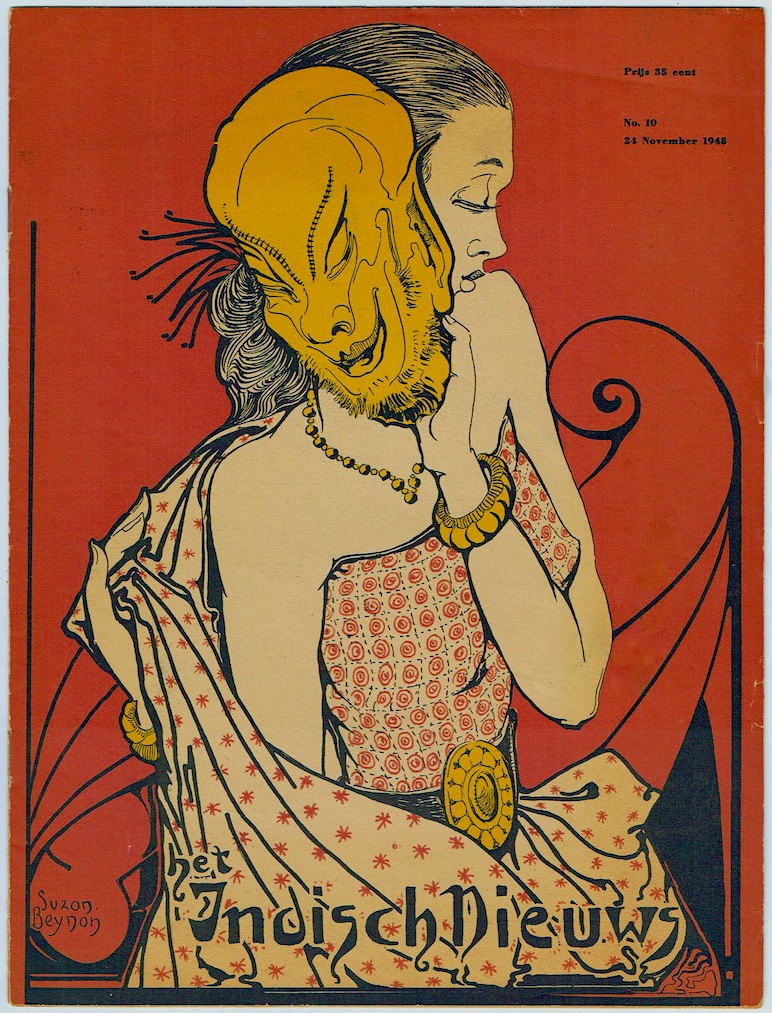
The cover of this edition (November 24, 1945) was designed by Dutch-Indies artist Suzon Beynon, who gave drawing lessons in Bandung. During World War II she moved to England, Australia and the USA. Beynon worked in a late Symbolist style. It’s a bit of a guess what she wanted to express with this color woodcut, but the woman on the cover probably personifies Indonesia. She’s depicted as a dancer or actress taking off her stage mask. The woman turns her head away as if she doesn’t dare look us in the eye.
The demonic mask with Asian features refers to the Japanese occupation of the Dutch East Indies during World War II, when the Dutch and Indo people were locked up in prison camps. It came as a shock to them that many Indonesians saw the Japanese as liberators. Now that the war was over, Indonesia would once again show its true face behind the Japanese mask.
Propaganda
Beynon’s naive romanticized image symbolizes the hope of many Dutch and Indo people that everything would return to the way it was before the war. They believed that a small part of the Indonesians had let themselves be incited by the Japanese, but that the majority of the population did not support a violent struggle for independence and wanted to remain part of a federal union with the Netherlands at the helm. This idea was fueled by state propaganda, which was propagated by patriotic newspapers and magazines such as ‘Het Indisch Nieuws’.
Despite this sensitive and historical context, I personally think it’s a beautiful cover design. It expresses well the melancholy and longing for the past, which is still alive today among many Dutch people who have a bond with Indonesia.
 Art Deco Bali blog