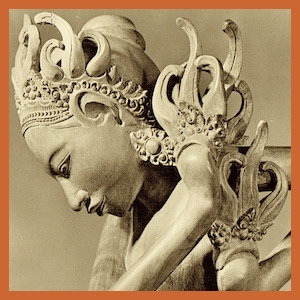
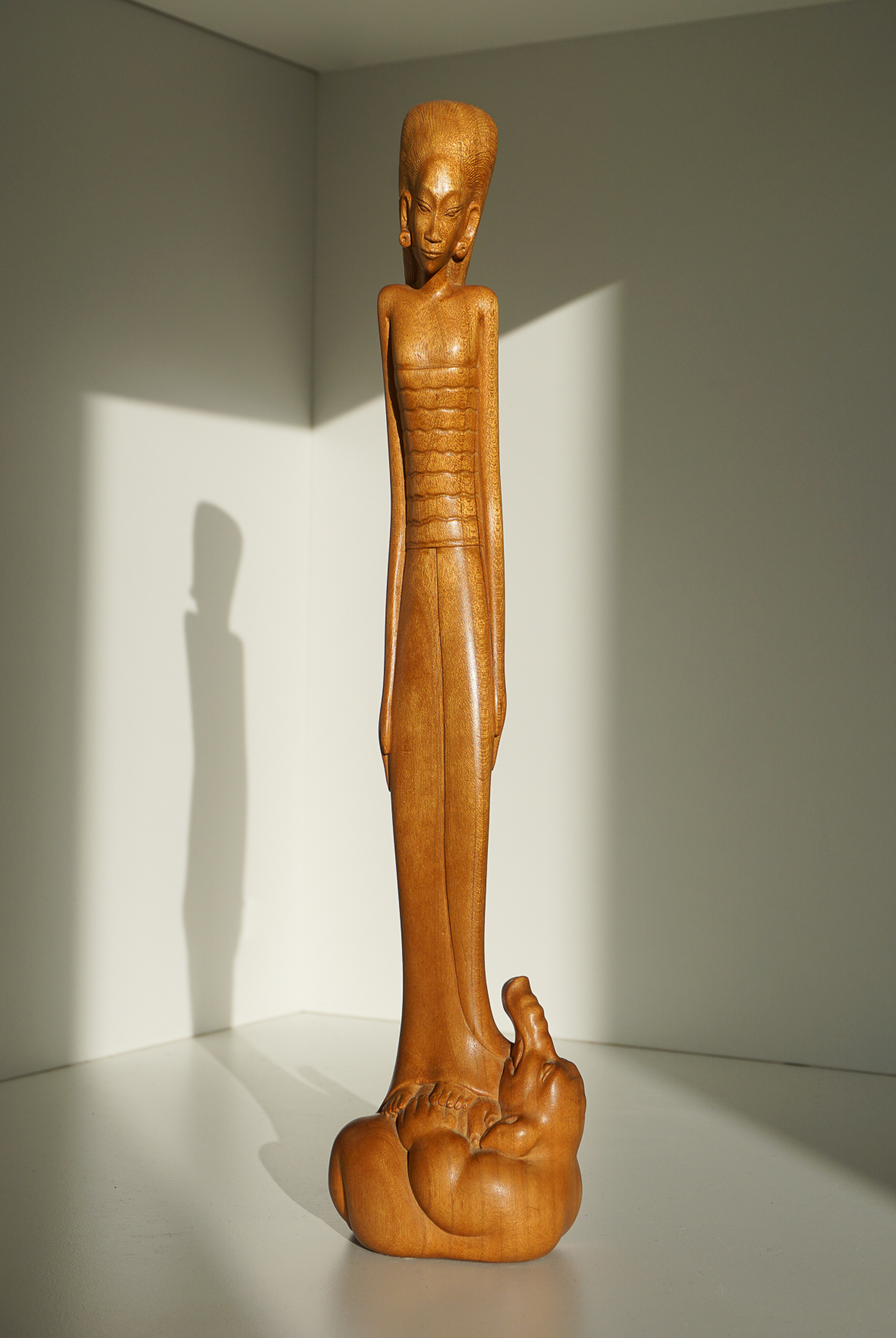
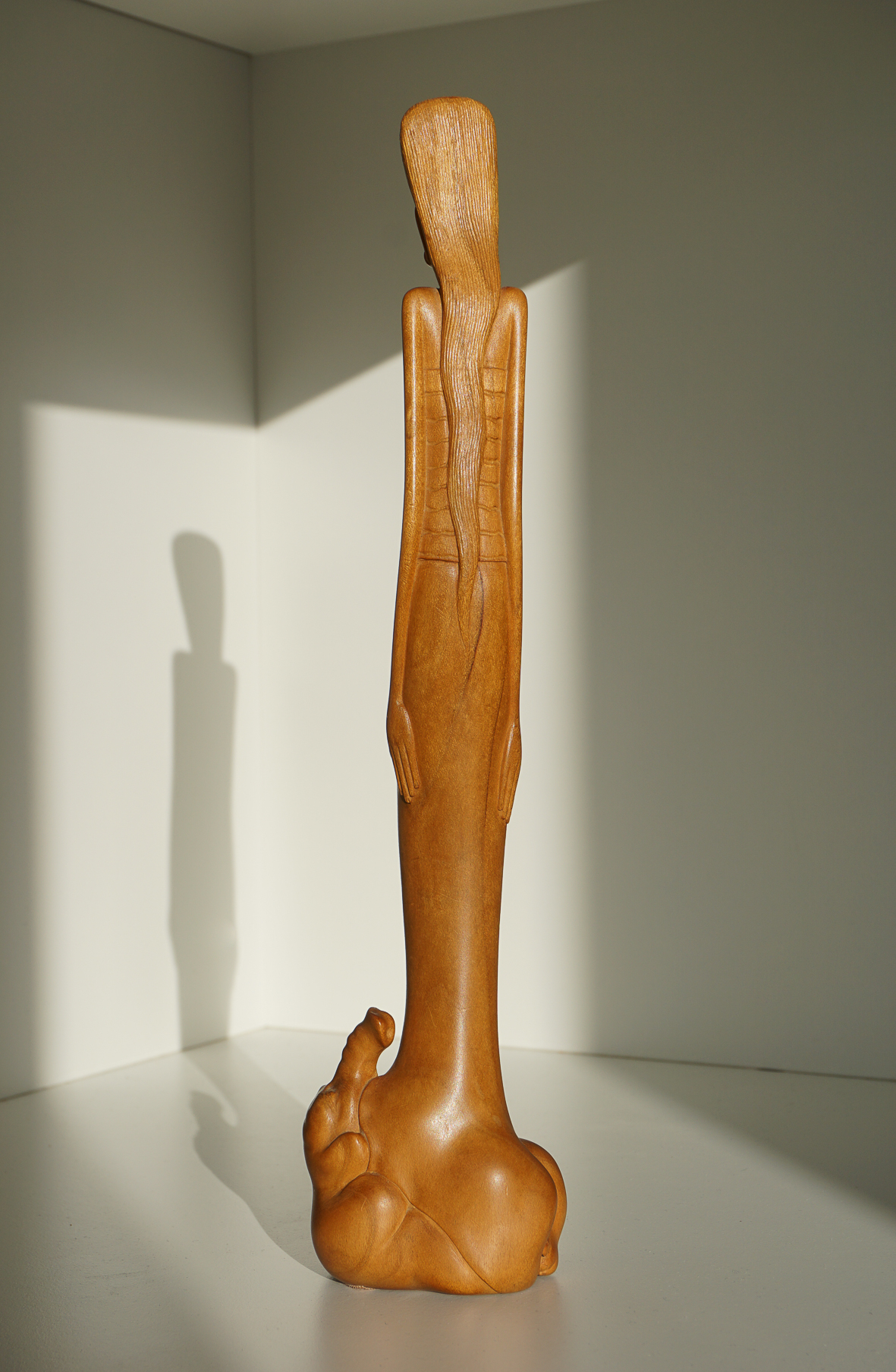
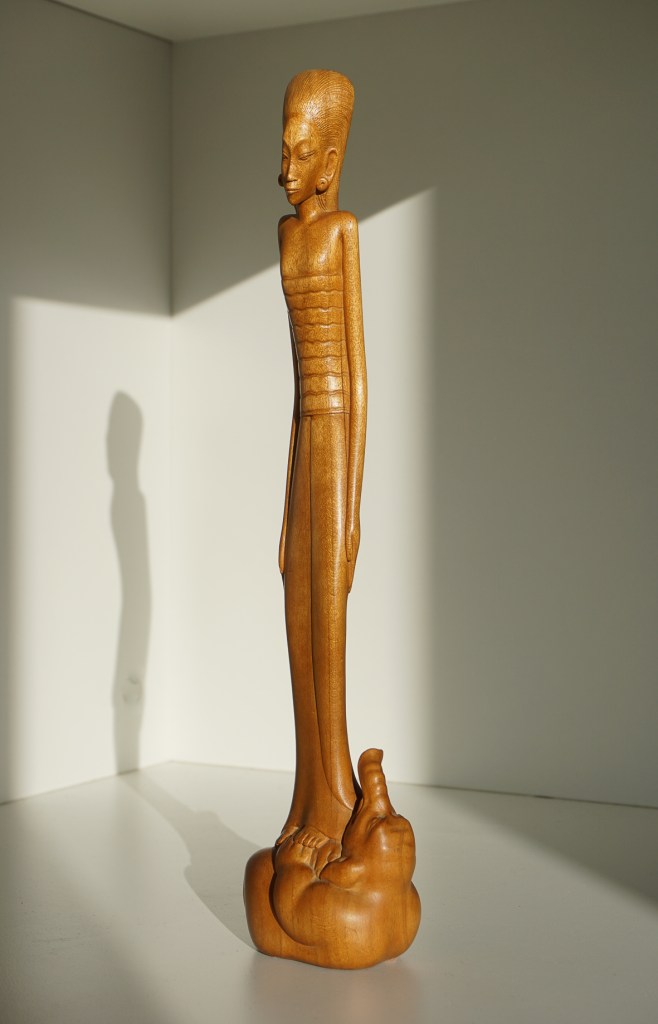
My collection Balinese wood carvings started with this elongated figurine of the goddess Dewi Uma (or Parvati) with her son Batara Gana (or Lord Ganesha). He’s depicted as a child, as a chubby little elephant, while his mother is shown as a slender appearance with long hair and thin long limbs. This contrast between round and long straight shapes makes the figurine extra interesting as it combines two well-known Balinese Art Deco woodcarving styles: the elongated style and the round, “corpulent” style, both introduced by the famous woodcarver Ida Bagus Njana (1912-1985).
Rudolf Bonnet, a Dutch painter living in Bali and one of the founders of the Balinese artists’ association Pita Maha, was very fond of Njana’s work and wrote about him:
‘In spiritualization and refinement, no sculptor of Mas went further than Ida Bagoes Njana, whose rare creations sometimes resemble thin, immaterial dream forms, wondrous appearances, which have nothing more to do with a sculpture, a last genius expression of an art that is going to dissolve itself.’
Njana’s elongated style also appealed to the tourists and was soon adopted by other woodcarvers. As the new style became more and more mainstream and many of his creations were copied by other woodcarvers, Njana decided to change tack at the beginning of the 1950s. From that moment on he also made statues of figures with round, corpulent shapes. The nice thing about my Dewi Uma and Gana sculpture is that it combines both styles.
Ida Bagus Tilem
This sculpture was probably carved by Njana’s son, Ida Bagus Tilem (1936-1993), who had learned the craft from his famous father. In 1960 they founded the Njana Tilem Gallery together, which was expanded with its own museum after Tilem’s death in 1993. In addition to being a gifted woodcarver, Ida Bagus Tilem was also a good teacher. He passed on his knowledge to many aspiring young artists and was therefore very important for the development of modern woodcarving in Bali.
His wood carving represents the birth of Gana, god of intellect and wisdom. According to the Javanese Smaradahana poem from the 12th century, Gana was born with an elephant head because his mother Uma was frightened by Indra’s giant elephant Erawan when she made love to her husband Siwa. This story differs from the Indian version where Ganesha (the Indian name for Gana) is given an elephant head after Shiva (Siwa) in a rage beheaded his own son. In the Balinese version, Gana is already born with an elephant’s head, which also explains why Tilem depicted him as a baby elephant. The statue is delicately carved with nice details. See, for example, how Gana’s little trunk lovingly reaches up to his mother. The text ‘Bali 1957 R.B’ is scratched at the bottom, which was probably done by the first owner as a memory of a trip to Bali.
In remembrance of marc van der bolt and dirk honing
This wood carving is very special to me because it’s an heirloom of my dear friends Marc van der Bolt and Dirk Honing, who first drew my attention to the beauty of Balinese woodcarving. During his military service in Indonesia, Dirk had become attached to the country and its people. ‘We Dutch had no business there,’ he often said. ‘But we were young and we were sent by the government. We had to go there.’ Marc and Dirk’s house was full of beautiful art, including several Balinese wood carvings. The little statue of Uma and Gana, bought by Marc at an antique shop, was their favorite. After they both passed away, I received the figurine of their families as a memento of our special friendship and started my own collection.
 Art Deco Bali blog