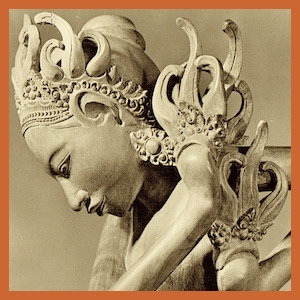

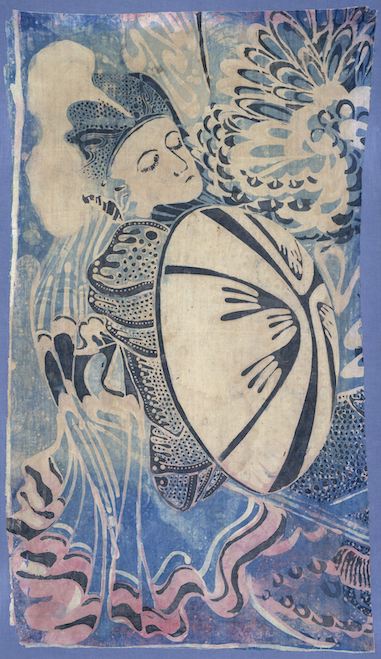
This Dutch East Indies banknote from 1939 was designed by the Dutch art nouveau artist Carel Adolph Lion Cachet.
Carel Adolph Lion Cachet (1864-1945) was one of the pioneers of the Dutch Art Nouveau movement. He was the first Dutch artist to master batik in 1891 and the first to apply this Indonesian textile dyeing technique to other materials, such as parchment. But Lion Cachet was probably best known for his lavish interior designs for the passenger ships of Stoomvaart Maatschappij Nederland (SMN) and Koninklijke Paketvaart-Maatschappij (KPM). These steamships that sailed to Java and the other islands were very luxuriously furnished and looked on the inside more like posh hotels than ships.
In 1928 Lion Cachet made a tour with the SMN to the Dutch East Indies. Together with his wife and daughter he visited Sumatra, Java and Bali. From this trip he took home several souvenirs, such as ikat and batik textiles and ceremonial daggers (keris), which he could use for his own designs. In 1930 he received the important assignment from the Javasche Bank to design a new series of banknotes for the Dutch East Indies.
Wayang wong performers
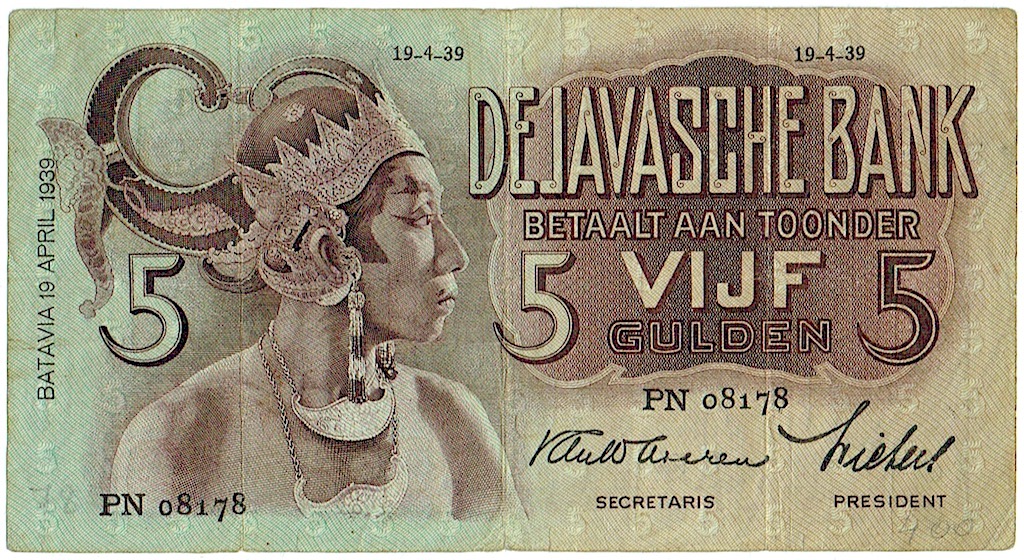
Wayang wong players from the courts of Solo and Yogyakarta are depicted on the banknotes. These royal dancers were chosen by the bank to emphasize its important status as the first bank of the Dutch East Indies.
The 5 guilder banknote shows a nobleman from Solo with a richly decorated dancing crown that is worn during the Wayang Wong performance.
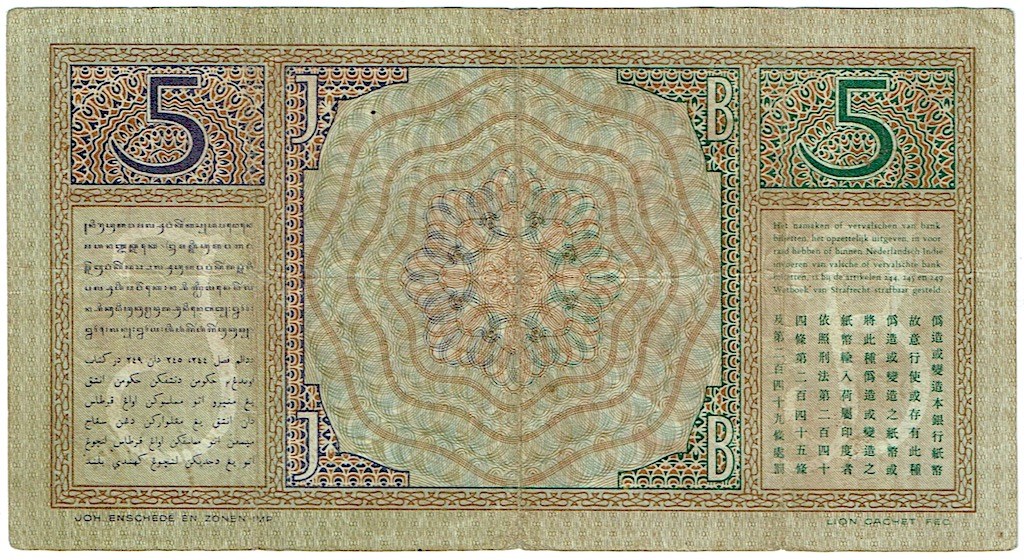
The back of the 5 guilder note is decorated with an oriental guilloche ornament.
10 guilder note
The 10 guilder note shows a nobleman and princess from Solo with beautiful headdresses, surrounded by ornate border ornaments.
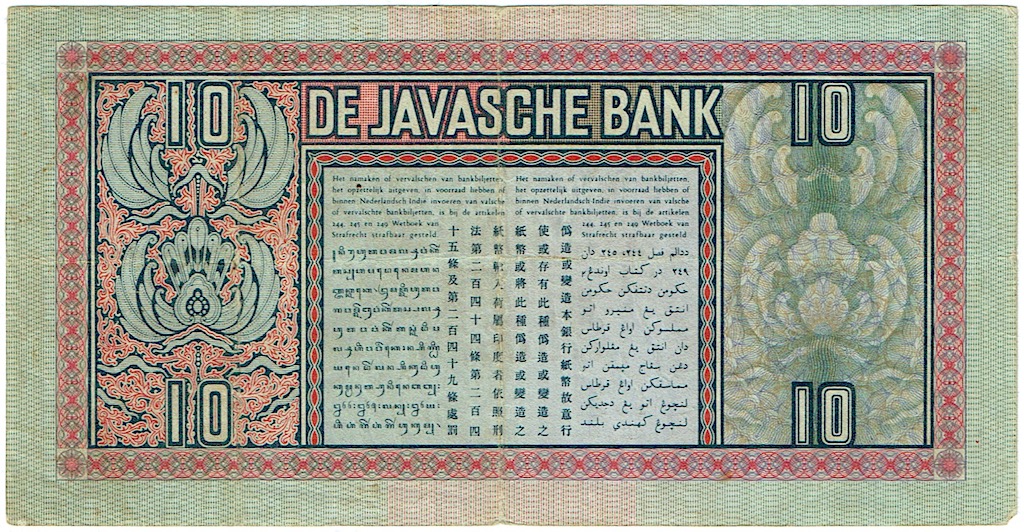
The reverse side of the 10 guilder note is decorated with the royal sawat motif, a stylized Garuda bird. Lion Cachet copied this Javanese motif from a batik sarong from the collection of the Colonial Institute in Amsterdam.
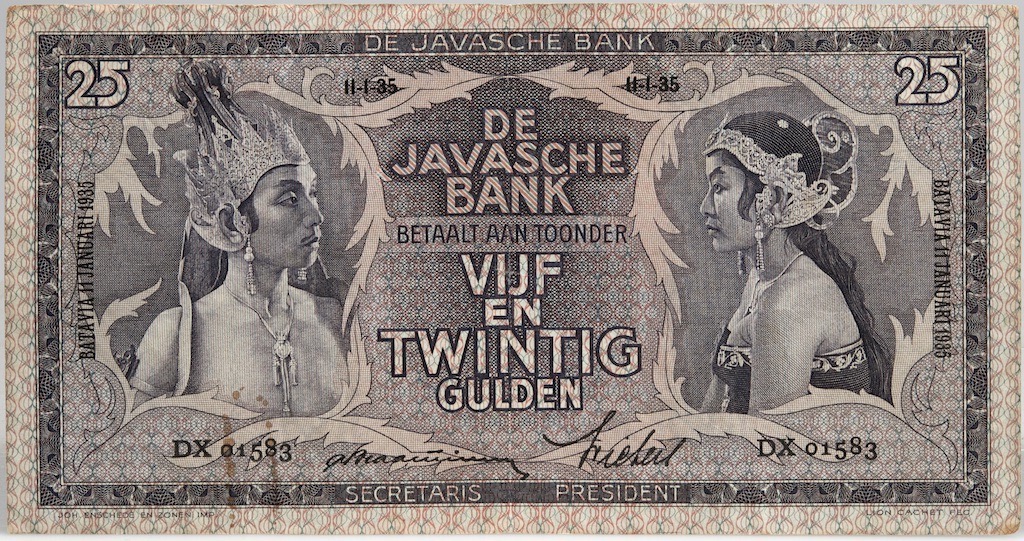
25 guilder note
The 25 guilder note shows a male and female court dancer from Solo, surrounded by decorative borders of leaves.
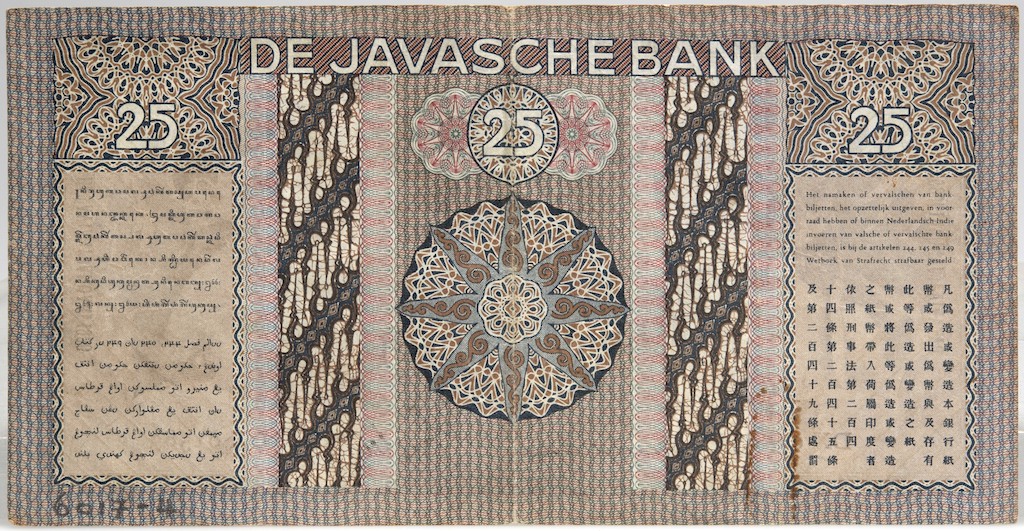
The reverse side of the 25 guilder note is decorated with vertical strips of the batik motif ‘Parang Roesak’, which could only be worn by the monarchs of Solo. A stylized gong is depicted in the middle.
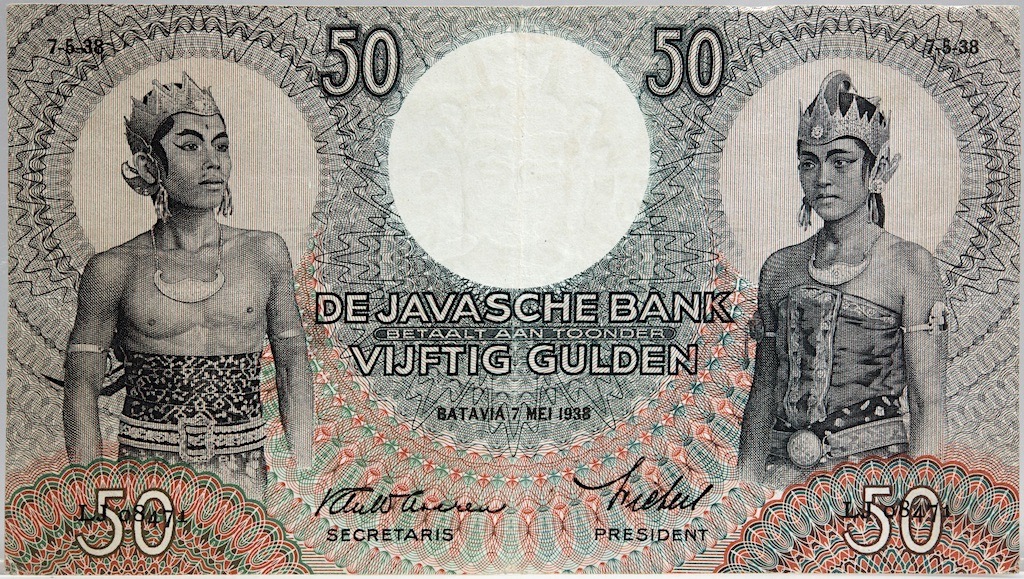
50 guilder note
The 50 guilder note is also decorated with two noble court dancers from Solo. The background consists of rosette guilloches, which are arranged around the portraits like halos. The watermark of the goddess of justice and truth can be seen in the third, middle halo.
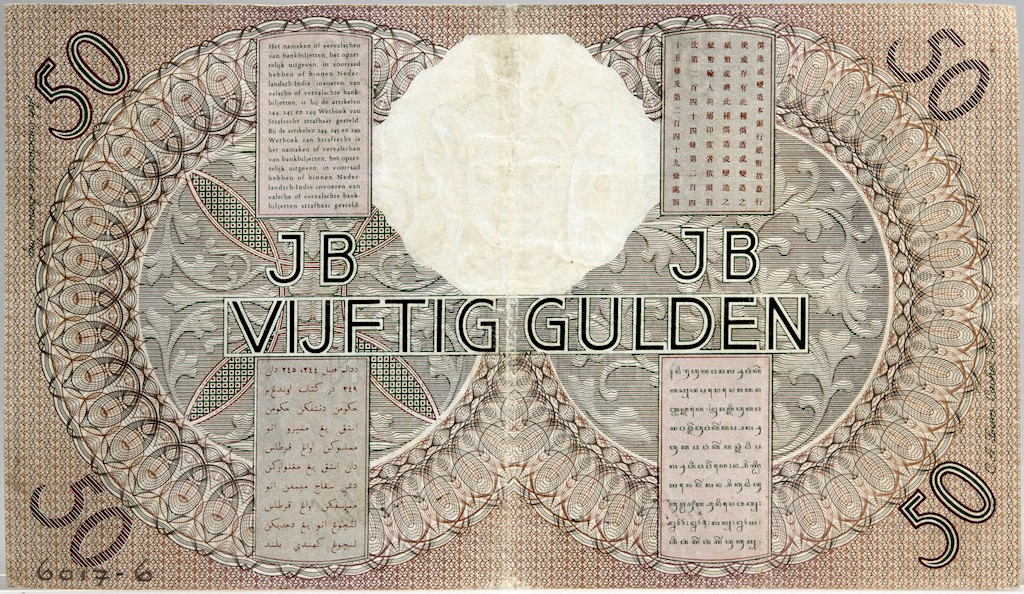
The back of the 50 guilder banknote is decorated with motifs after two silver dishes from Riouw, which are enclosed by guilloche wreaths. In the blank space, the aforementioned watermark of the goddess of justice and truth can be seen. The face of the goddess is based on an ancient Hindu-Javanese sculpture that was taken away by the Dutch regime and displayed in the Museum of Ethnology in Leiden.

100 guilder note
Two noblemen from Yogyakarta are depicted on the 100 guilder banknote. Lion Cachet actually made this design for the 1000 guilder note, but the bank board liked it so much that they asked him to use it for the 100 guilder note, because this note was much more in circulation.
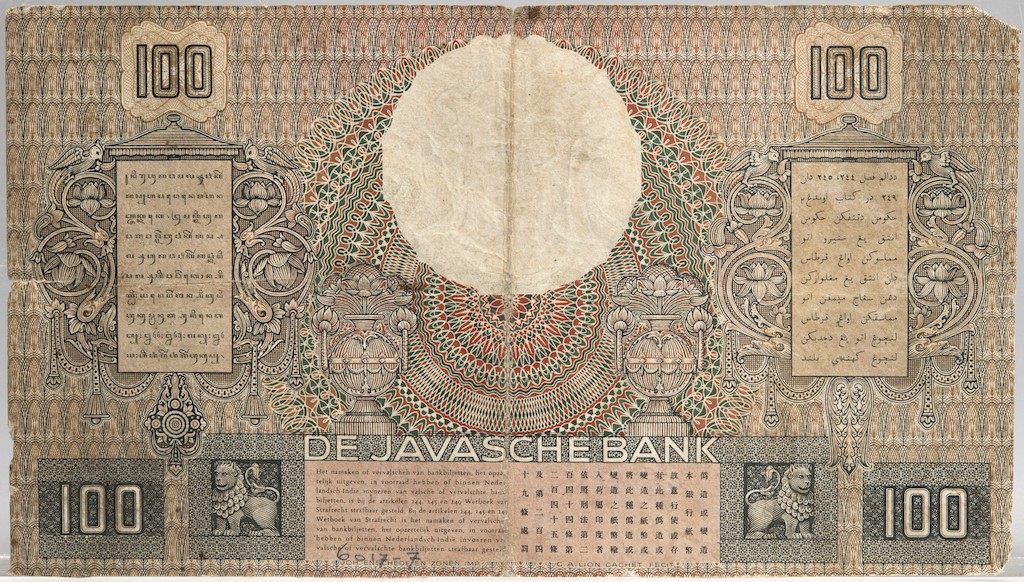
The back of the 100 guilder banknote is decorated with a stone relief of the Borobudur with lotus flowers and birds and motifs of flower vases and Asiatic lions, which are also a reference to the lions in the royal coat of arms of the Netherlands.
Photography for this post: The (photos of the) 5 and 10 guilder notes are my own. The photos of the other banknotes have been taken from the website of the Dutch Cultural Heritage Agency. These banknotes are part of the collection of the National Museum of World Cultures.
 Art Deco Bali blog